
The next eight days could bring good showers over SA wheat growing areas

South African Agricultural Commodities Weekly Wrap
August 31, 2018
Russia will not cap its wheat exports in 2018/19 season
September 4, 2018
- The Western Cape is the only province with a large share of dryland wheat and therefore prone to weather risks. Fortunately, the weather conditions have been quite favourable this year, with a fair amount of rainfall over most parts of the province. The only winter wheat growing area that did not receive an adequate amount of rainfall is the southern Cape, hence there have been reports of crop damages.
- Looking ahead, the next eight days could bring heavy rainfall of between 20 and 70 millimetres over the Western Cape province. This is a welcome development as the crop is at the pollination stage of development that requires moisture. Nonetheless, the areas that had already experienced crop damage in the southern Cape regions might not be able to recover at this stage.
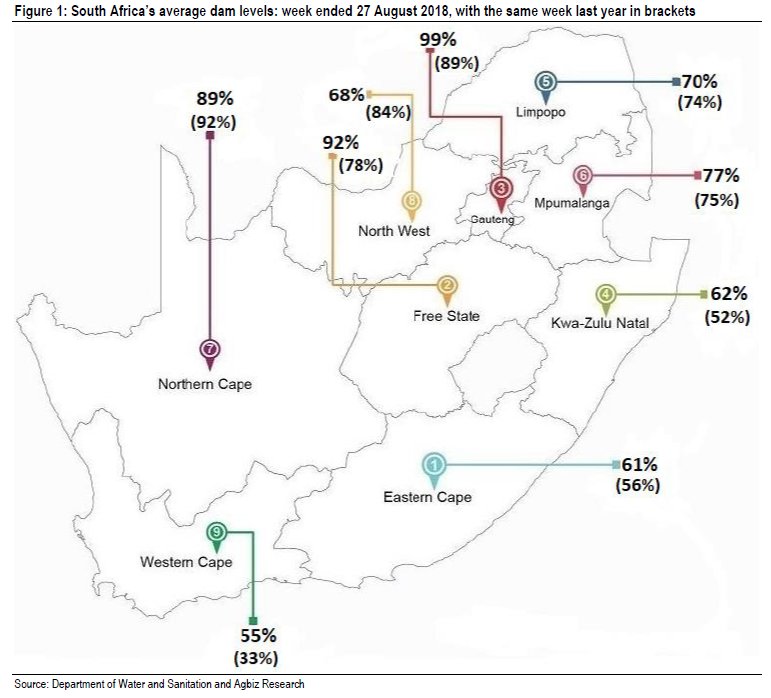
- The expected rainfall will not only improve soil moisture and benefit crops but also improve dam levels. The most recent data from the Department of Water and Sanitation shows that the Western Cape provincial dam levels averaged 55 percent in the week of 27 August 2018, up by a percentage point from the previous week and 22 percentage points higher than the same period last year.
- Furthermore, the forecast rainfall is not only limited to the Western Cape but also other winter wheat producing provinces, with the exception of Limpopo which could experience cool and drier weather conditions over the observed period. This is not much of concerns as the irrigation areas of the province could benefit from higher dam levels (see Figure 1).
- The favourable weather outlook supports the Crop Estimate Committee’s view of an 18 percent annual recovery in wheat production to 1.8 million tonnes. Most importantly, as a result of an uptick in domestic production, wheat imports could decline by 33 percent from the 2017/18 season to 1.4 million tonnes. This is according to data from the national Supply and Demand Estimate Committee.
Click HERE to read the full report
Related posts


Wednesday November 6th, 2019